
Document status: Public Gameplay Guide v1.0
Implementation reference: GAME_DESIGN.md
This guide explains the current Flutter runtime's core rules from the player's perspective. If values conflict, check the running code, regression tests, and implementation reference in that order; no substitute rule is applied.
#The game in one sentence
SLIVERS is a poker roguelike built around a standard deck and a network of character records. You trade the stable credit of Upper against the high output and Bio Load of Lower to clear a single target that doubles every round across an 18-round run.
#One run
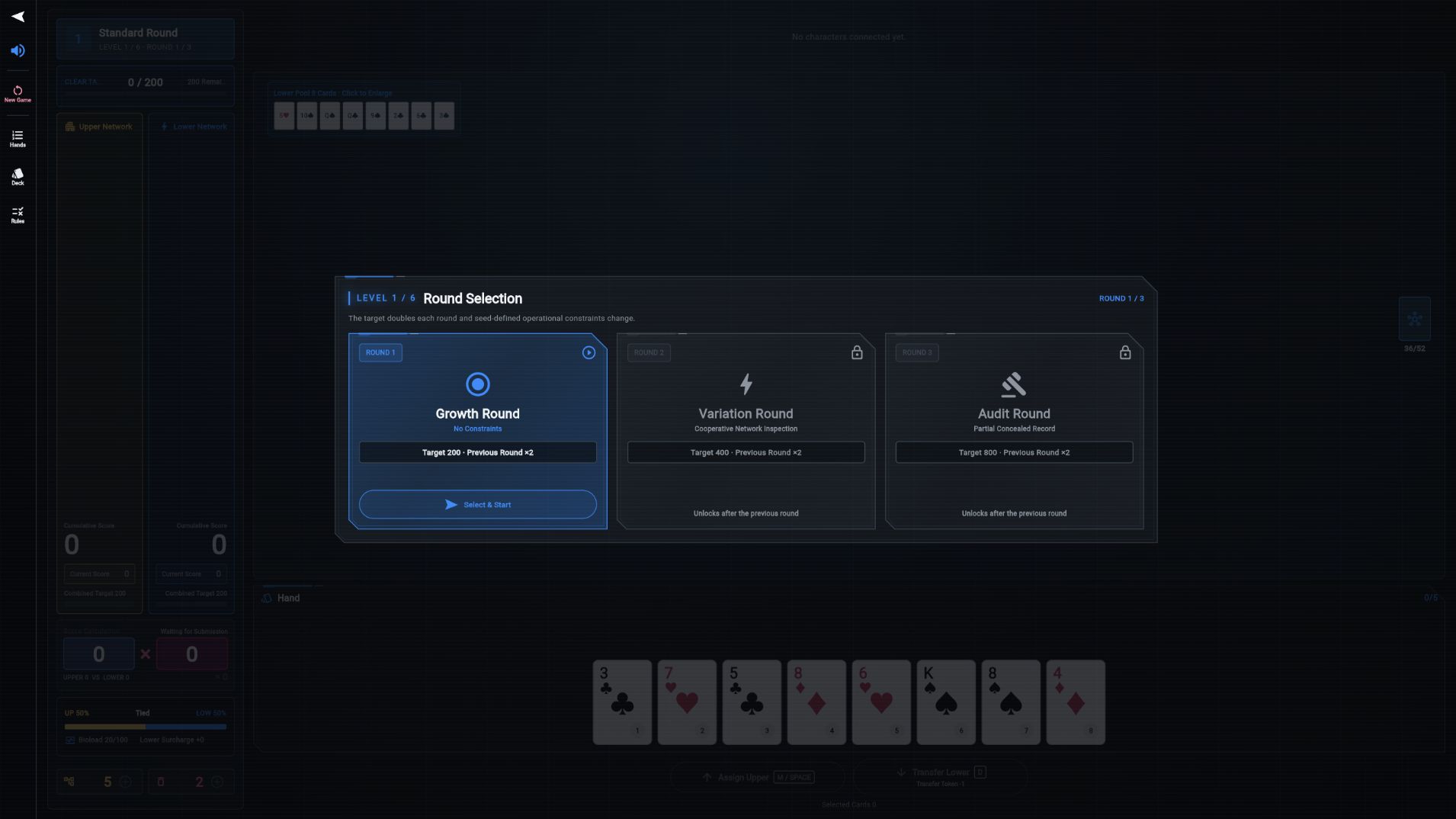
A run contains six sectors with three rounds each, for 18 rounds in total.
- Review the seeded constraint for the round.
- Draw an eight-card hand from the standard 52-card deck.
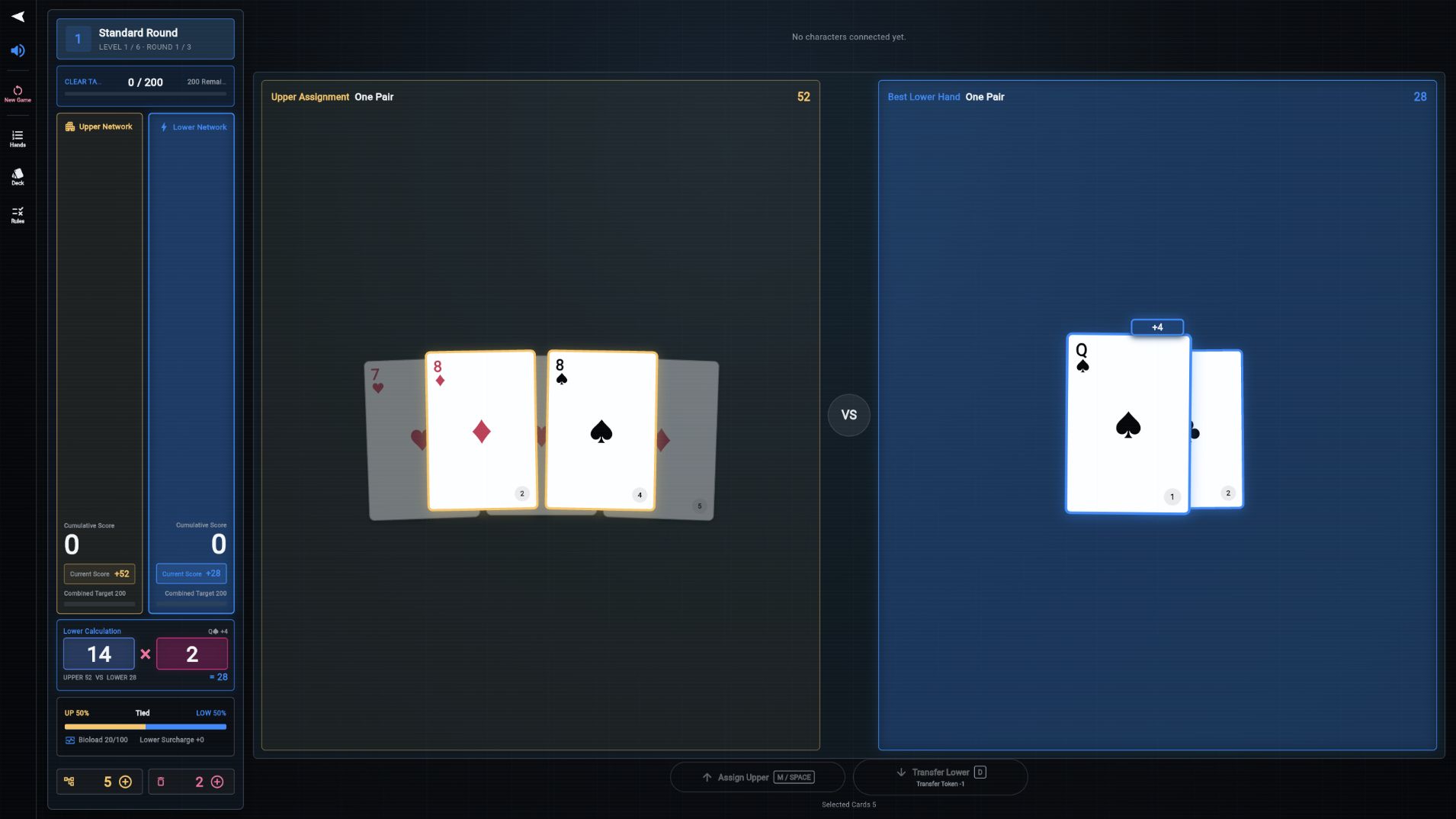
- Select one to five cards and assign them to Upper or Lower.
- If needed, discard one to five cards to rebuild your hand.
- Clear the target, resolve settlement and an event, then grow at the Relay Station.
- Reshuffle the full deck, preserving permanent changes, and enter the next round.
The default action limit is five assignments and two discards per round. Assigned and discarded cards move to that round's exhausted record and cannot be used again during the same round.
#Win condition
Upper and Lower do not have separate, competing targets. Add the score produced in both directions and clear the current round's single target.
Round Total = Upper Score + Lower Score
Round Target = 200 × 2^(Round - 1)
Clear = Round Total ≥ Round Target
The first target is 200; the Round 18 target is 26,214,400. The curve grows
by exactly ×131,072 from its starting point. If the target is still unmet after
all assignments are spent, the run ends.
#Upper and Lower
#Upper
- Scores primarily from the sum of scoring-card ranks.
- Direction multiplier:
×1.00. - More stable, with a higher Credit settlement.
#Lower
- Builds its base contribution primarily from the number of scoring cards.
- Direction multiplier:
×1.25. - Raises score quickly, but adds a Bio Load surcharge based on Lower's score share.
Lower Share = Lower Score / Round Total
Lower Surcharge = ceil(Sum of Round Activity Load × Lower Share)
At 100% Lower share, the round's activity load is effectively doubled. If Bio
Load reaches 100 during an action or settlement, the run collapses immediately
regardless of score. There is no automatic balance recovery.
#Poker hands and progression
The game uses 12 hands. Alongside standard poker hands are Five of a Kind, Flush House, and Flush Five, which are only possible after deck duplication or rank and suit editing.
- Clearing a round raises the shared mastery of one hand used that round for free.
- At the Relay Station, Credits can raise any chosen hand further.
- Starting Authorities grow the deck multiplier through
×1/2/4/8as their action conditions are completed. - Card modifications alter rank, suit, direction, and hand conditions.
- Original Protocols permanently or provisionally alter deck deletion, duplication, rewriting, and the next constraint.
#Credits and cooling
One Credit currency covers both purchases and cooling during a run. There is no separate stored-cell resource.
| Item | Default |
|---|---|
| Starting Credits | 8 C |
| Base cap | 50 C |
| Cooling | 5 C → Bio Load -15 |
| Cooling limit | Once per Relay Station |
| Settlement | 5 C at 100% Lower, 8 C at 100% Upper |
| Over-target bonus | Up to +2 C |
The central choice is whether to invest Credits in growth or reserve them for cooling before the next round.
#Constraints and events
The run seed and round number determine the round constraint, which is disclosed before actions begin. Constraints include partial face-down records, attenuation of specific suits or high ranks, repeated-hand audits, modified-output limits, and network inspection. Round 1 has no constraint; Round 18 combines two distinct constraints.
After a clear, choose an event and a City Ordinance. Ordinances can improve hand size, discards, assignments, slots, settlement, or cooling, but every choice has a Credit cost and an opportunity cost.
#Character network
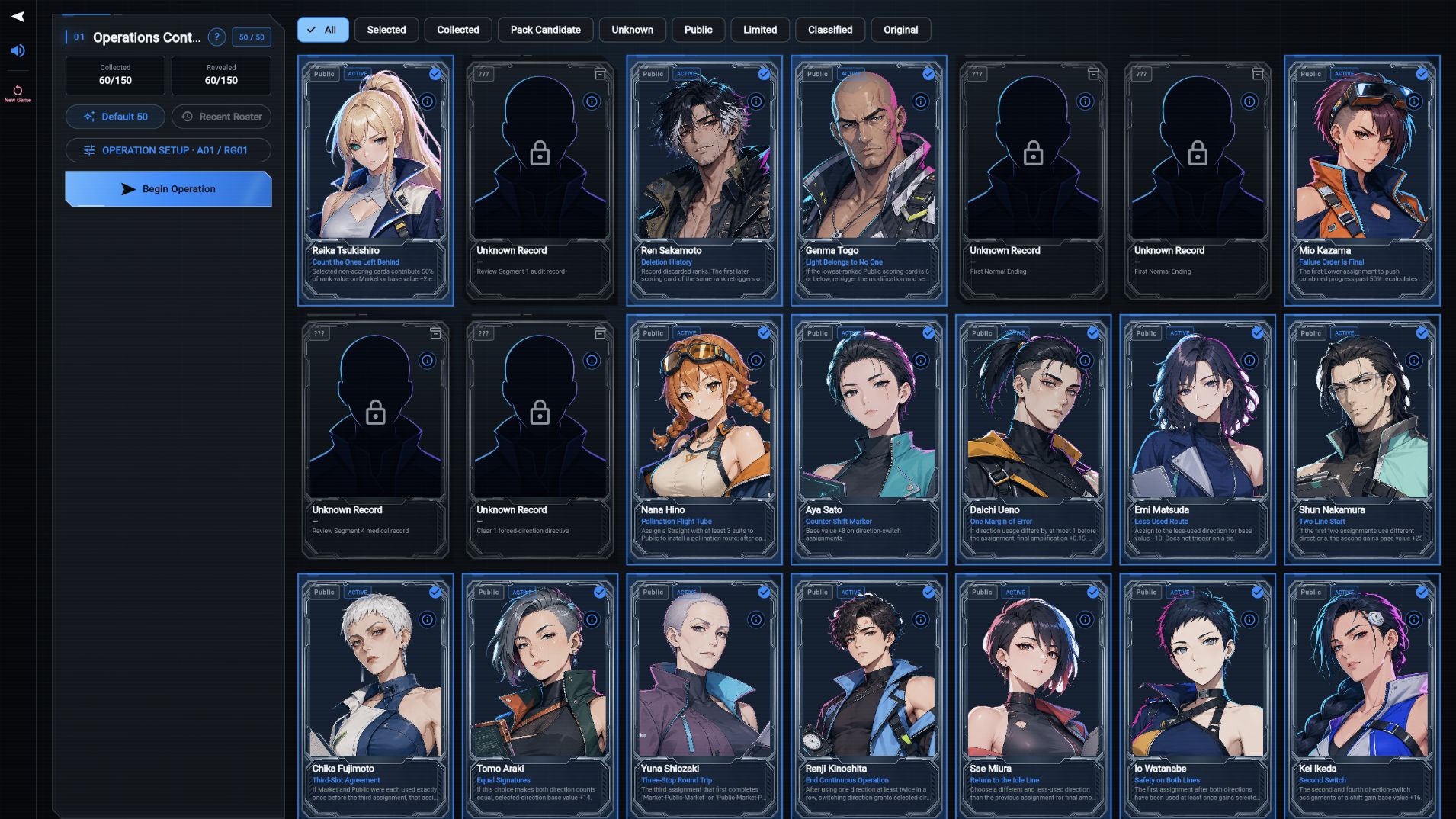
There are 150 character records. The current runtime executes 122 with unique
rules and explicitly marks the remaining 28 as deferred. Unimplemented
characters do not receive a generic or inferred replacement effect.
Characters are not simple score bonuses. They connect assignment order, card state, poker hands, resources, events, and protocols. Choosing who occupies each slot matters as much as building the deck.
#Run end and endings
A run ends when any of the following occurs:
- Bio Load reaches
100. - The round target can no longer be reached with the remaining assignments.
- All 18 rounds are cleared and an ending is confirmed.
Clearing Round 18 confirms either the normal route or the Original-comparison route. Endings do not use the Upper/Lower ratio; they use collected Original Keys, record flags, and protocol results.
#Current availability
- Web, iOS, and Android use the same game rules.
- Save schema 11 preserves the dynamic deck, duplicated cards, mastery, constraints, and scheduled effects.
- Reloading the same seed and save state does not change the deck, constraints, or face-down-card results.
- Game reward requests and payouts remain disabled until the server can authoritatively verify the full run.