
Document status: Implementation Reference v1.0
Detailed values: EXPONENTIAL_LEVEL_DESIGN.md
#1. Product statement
A roguelike in which a standard poker deck and 150 cooperative records shape Upper and Lower output. Trade Lower's rapid score growth against Bio Load risk to clear a target that doubles for 18 rounds.
#2. Run cycle
- Six sectors, three rounds per sector, 18 rounds total.
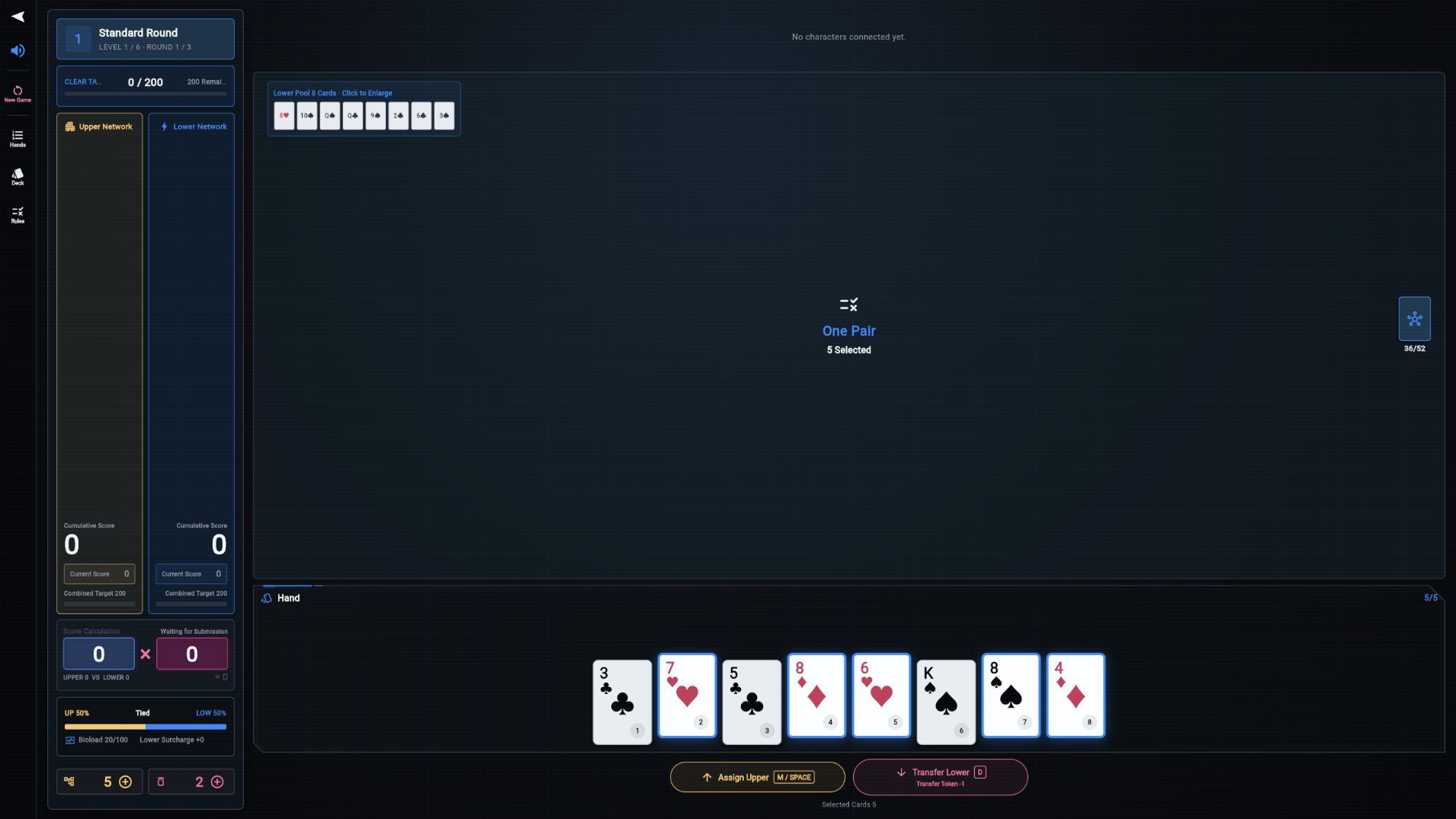
- Standard 52-card deck, eight-card hand, five assignments, and two discards.
- Select one to five cards at a time and assign them to Upper or Lower.
- Assigned and discarded cards move to the exhausted pile for that round.
- At the next round, reshuffle the entire deck while preserving permanent changes.
- Clear target → settlement → event/ordinance → Relay Station → next round.
#3. Single clear condition
Round Total = Upper Score + Lower Score
Round Target = 200 × 2^(Round - 1)
Clear = Round Total ≥ Round Target
Upper and Lower have no separate targets. There is no additional ending condition that requires a particular ratio, balance, or direction. If all assignments are spent and the total is insufficient, the run ends.
#4. Scoring
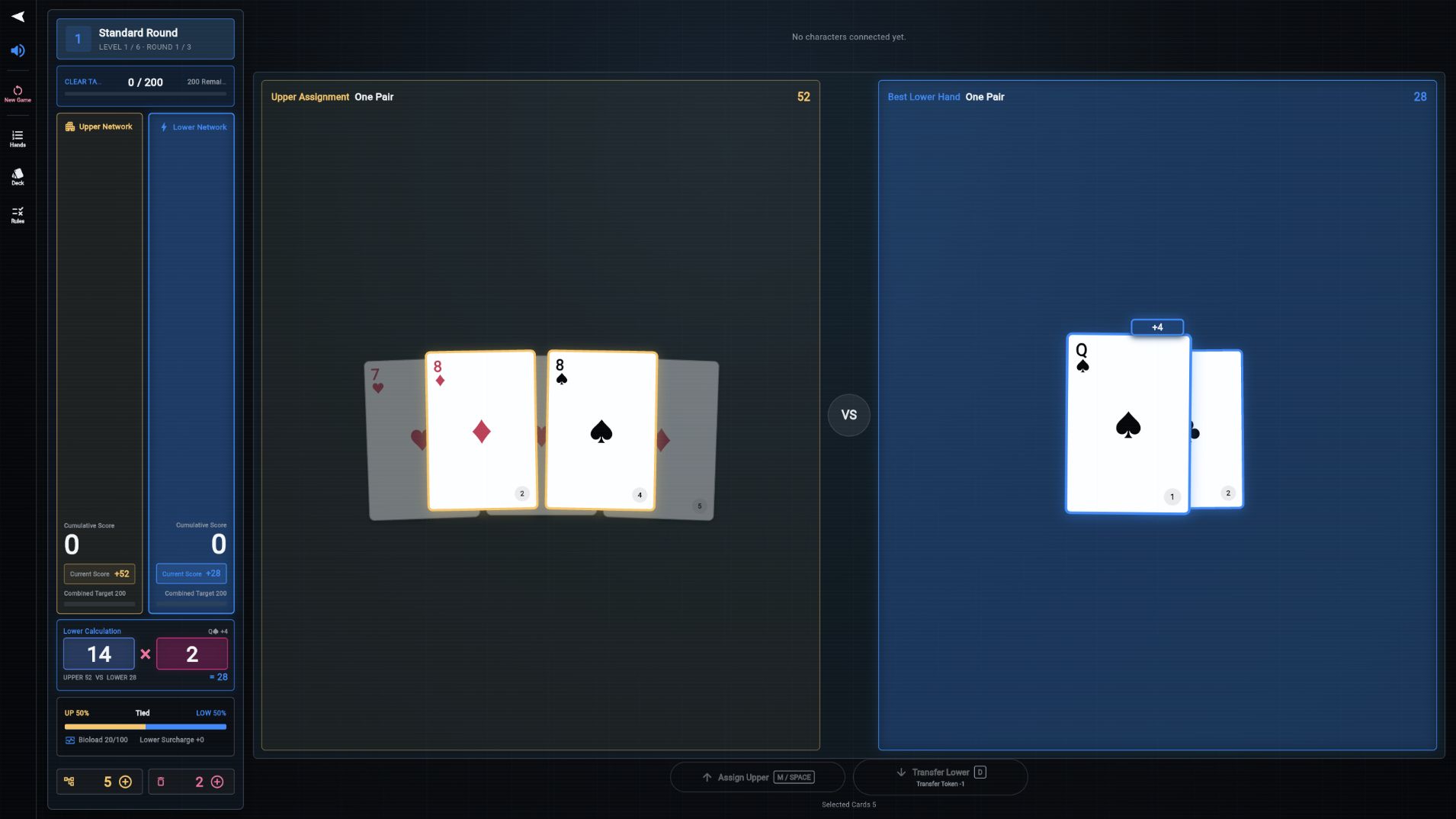
Upper uses the sum of scoring-card ranks; Lower uses a contribution based on the number of scoring cards. Existing character additions and card modifications are combined first, then the multipliers below are applied.
Final Score = floor(
  Base Score
  × Shared Hand Mastery Multiplier
  × Direction Multiplier
  × Starting Deck Growth Multiplier
  × Operational Constraint Multiplier
  × Original Data Multiplier
)- Upper direction multiplier:
×1.00. - Lower direction multiplier:
×1.25. - Hand mastery uses one shared level regardless of direction.
- Starting deck growth multiplier progresses through
×1/2/4/8as conditions are met. - Each Original card adds
+0.20; each triggered Original character adds+0.10.
#5. Poker hands and mastery
H01–H12 are used. H10 Five of a Kind, H11 Flush House, and H12 Flush Five become possible in decks whose duplication, ranks, or suits were edited by Original Protocols.
Mastery Multiplier = 2 ^ ((Shared Level - 1) / Growth Interval)On a round clear, one hand used during that round gains +1 for free. If only one hand was used, it is raised automatically. Additional mastery can be purchased with Credits at the Relay Station.
#6. Bio Load
Every assignment immediately creates activity load based on the hand's risk. At round end, the sum of activity load is multiplied by Lower's score share, rounded up, and added once more.
Lower Share = Lower Score / Round Total
Lower Surcharge = ceil(Sum of Round Activity Load × Lower Share)
At 100% Lower, activity load is effectively doubled. If Bio Load reaches 100 during play or round settlement, the run collapses immediately regardless of the score. There is no automatic balance recovery.
#7. Credits and cooling
There is no stored-cell resource. Every purchase and cooling action uses Credits.
- Default starting Credits: 8; default cap: 50.
- Default cooling:
5 C → Bio Load -15. - Cooling is available once per Relay Station.
- Base settlement is 5 C at 100% Lower and 8 C at 100% Upper.
- Up to +2 C is added according to the amount above target.
#8. Operational constraints
The run seed and round number determine each constraint, which is disclosed before the round briefing.
- Partial face-down records.
- Specific-suit attenuation.
- High-rank attenuation.
- Repeated-hand audit.
- Modified-output limit.
- First-slot network inspection.
Round 1 has no constraint; Round 18 combines two distinct constraints. A kind
that appeared in the previous two rounds cannot appear again. LP13 rerolls the next
constraint to a different result; LP14 removes the next constraint.
#9. Progression axes
- Eight Starting Authorities: each reaches a
×8deck multiplier through a different action pattern. - Shared hand mastery: free growth every round plus additional Credit investment.
- Card modification: stronger rank, suit, direction, and hand conditions.
- 150 characters: 122 unique runtimes and 28 explicitly
deferred. - 18 Original Protocols: change deck size, card identity, mastery, slots, and the next constraint.
- 16 City Ordinance pairs: improve hand size, discards, assignments, slots, settlement, and cooling.
There is no fallback that assigns arbitrary group-wide effects to unimplemented characters.
#10. Saving and determinism
Save schema 11 records dynamic deck size, duplicate-card IDs, Original cards and characters, shared mastery, executed protocols, next-round schedules, and constraint salt/shields. Reloading the same save does not change the deck, constraints, or face-down cards.
#11. Endings
Clearing Round 18 confirms either the normal route or the Original-comparison route. No Upper/Lower balance condition is used to determine the ending. The Original route uses collected Original Keys, record flags, and protocol results.